
A backyard art studio is one of those spaces that only works properly when it’s been thought through carefully. Get it right, and it becomes the most-used room on the property – a dedicated creative space that’s always there, always ready, and always a source of inspiration.
Get it wrong, and it becomes somewhere you rarely use. A space that hinders rather than helps your creative flow.
The good news is that the decisions that make the difference aren’t complicated.
Here’s what the artists, potters, photographers and other creatives who’ve built studios with Greenspan consistently get right.
In this article:
- How much natural light do you need — and where should it come from?
- What’s the best wall lining for an art studio?
- What flooring works best in a creative space?
- Should you add a sink?
- What about power and lighting?
- How do you manage noise?
- What furniture and storage do you actually need?
- Real art studios – from real customers

How much natural light do you need – and where should it come from?
The right natural light is the single most important design consideration for an art studio. It affects how colours appear, how long you can effectively work, and how the space feels to be in. And because even the best artificial lighting fails to match good natural light, maximising how much is received through the day is as important as its quality.
For most artists in Australia, indirect south-facing light is ideal – it’s diffused, and free from the harsh shadows and colour shifts that direct sunlight can create. And most importantly, it remains consistent throughout the day and through the changing seasons.
That’s why window and door placement matters so much, and why it’s worth thinking carefully about orientation before you finalise your design.
Unlike most garden buildings where windows and doors are fixed in position, every Melwood is designed to your specification – you choose how many openings you want, what size and style they are, and exactly where they go. This means you can maximise natural light according to your site and set-up without having to compromise on layout or the building’s orientation.
The Melwood Mod design is a popular choice for art studios because its signature highlight windows flood the interior with indirect natural light without sacrificing any wall space needed for shelving, artwork and equipment below.
Double doors with fixed glass sidelights are another popular combination – combined with the highlight windows, this creates almost a full wall of glass on one side and maximises both light and access. When you’re moving easels, canvases and large furniture in and out, that wide opening also makes a real practical difference.
For ventilation – an essential consideration for a studio where paints, solvents and other potent mediums are in use – at least one sliding window is also worth including. Positioned right, in conjunction with other doors and windows, it provides airflow and promotes the cross-ventilation needed to disperse any fumes.
Max Hamilton, children’s book author and illustrator, specifically designed her Melwood Workshed art studio around natural light – and the result is a space that works beautifully for her detailed illustrative work.
What’s the best wall lining for an art studio?
This depends entirely on how you work, as well as your style preferences – and it’s one of the most personal decisions in the whole interior design process.
Greenspan’s timber-framed wall construction means the cavity is already there – unlike single-skin buildings where there’s simply nowhere to put insulation or services such as power and plumbing.
Adding insulation batts to the wall cavities prior to lining them is straightforward and makes a significant difference to year-round comfort, keeping the studio cooler in summer, warmer in winter, and extending the hours you can comfortably work in it. Living in Canberra, Leanne was very glad to be able to add extra insulation when she built her pottery studio.
Additionally, cables and pipes can be hidden rather than left exposed. Soundproofing and acoustics are significantly improved when walls are insulated and lined. And there’s genuine choice with the finish.
Some creatives simply leave their studio walls unlined, like Lesley’s Workshed in Katoomba. The exposed timber framing provides natural built-in shelving for storage of materials and the display of work. It also gives the space an honest, workshop feel, and if your pursuits are naturally messy, there’s a strong argument for leaving the interior raw and rustic.
For those who prefer a more considered, polished interior, traditional plasterboard or Gyprock is the most common choice. It’s smooth, paintable, and gives the studio a clean, light-filled, finished feel that works well as a backdrop for colourful, creative work. Adding picture rails, like Laura did to her art studio, is a great way to display works in progress or finished pieces.
Plywood lining is a popular alternative – versatile, available in a range of finishes, and with a character that plasterboard can’t quite achieve. Painted white, it creates a beautiful blank canvas and helps bounce natural light around the interior. Left natural, it adds texture and warmth.
VJ panelling creates sleek lines, is easy to install and is often pre-painted or pre-primed, making it an easy, fuss-free DIY option. Pegboard is perfect for hanging and organising small tools – popular with woodworkers, jewellery makers, and potters.
You can also check out our guide to saving time and money with great wall lining options.
What flooring works best in a creative space?
Melwoods come with a smooth plywood floor as standard – and for many artists, that’s exactly what they keep for their studio.
Sealing or clear-coating the plywood is a particularly popular option. It highlights the natural grain of the timber, creates a durable surface that’s easy to clean, and delivers a warm, creative feel for very little cost. That’s exactly the approach hobby artist Eugenie chose for her studio.
The beauty of starting with plywood is flexibility. If your needs change over time, virtually any residential flooring can be installed over the top to suit. Floating timber floors create a polished finish, carpet adds warmth and comfort, while vinyl flooring offers durability and easy maintenance.
The best choice often comes down to the type of work you do. Potters, sculptors and artists working with wet or messy materials often favour vinyl or tiled surfaces because they’re simple to wipe clean and resistant to water. Painters, illustrators and photographers who spend long hours on their feet may benefit from adding anti-fatigue mats in key work areas, regardless of the flooring underneath.
It’s also worth thinking about how your studio might evolve. A creative space used primarily for painting today might become a mixed-purpose studio, office, gallery or teaching space in the future. Choosing a flooring solution that can adapt with you is often just as important as selecting one that suits your current practice.
Beneath it all, every Melwood is built on an elevated timber floor system supported by piers rather than a concrete slab. This approach allows the building to be installed on sloping or uneven sites with minimal groundworks, while providing airflow beneath the structure to help manage moisture and protect the building over the long term.
Can and should you add a sink?
Yes, you can. And for many creatives, it’s one of the most worthwhile additions you can make.
A sink in your art studio is one of those additions that sounds optional until you have one. Then it’s hard to imagine working without it. Cleaning brushes, washing hands between materials, rinsing pottery tools, filling water containers – these small tasks happen constantly throughout a creative session, and having to walk back to the house every time interrupts both your workflow and concentration.
The good news is that adding plumbing to a Melwood is entirely achievable as part of your fit-out. Greenspan’s timber-framed wall construction provides ample cavity space to conceal plumbing neatly within the walls, allowing a clean and professional finish without exposed pipework.
A simple basin and tap are all many artists need, while others choose to install a small hot water unit for added comfort during winter. If you’re already planning plumbing to the building, it’s also worth considering whether a toilet might add value. For artists who spend long days in the studio, teach classes, host clients, or simply want greater independence from the main house, a small bathroom can make the space significantly more functional and convenient.
The key is thinking about these requirements early. Your Design Solutioneer can help you consider practical locations for plumbing services – and help put you in touch with professional trades to carry out the task.
Like many aspects of designing your art studio, it’s easier and more cost-effective to allow for these possibilities from the outset than to wish you’d included them later.

What about power and lighting?
Power is one of those things that’s easy to underestimate when designing a studio.
Most creatives need far more than a couple of power points. Pottery wheels, sewing machines, computers, printers, photography equipment, power tools, chargers, speakers, heaters, fans and air conditioning all compete for power. And once you’ve worked in a comfortable, climate-controlled studio with your music playing and everything within reach – always fully charged and ready for use – it’s difficult to go back.
That’s why it’s worth thinking beyond your immediate needs. Consider where you’ll position your main workstations, whether you’ll need power along multiple walls, and how your creative practice might evolve over time. A painter today may be running a printer and photography setup tomorrow. A hobby potter may eventually invest in a wheel. A simple studio may one day become a fully equipped workshop or even a teaching space. It may even turn into something else entirely in the future – a home office, guest accommodation, or a home gym.
Once again, Greenspan’s timber-framed wall construction allows electrical wiring to be concealed neatly within the wall cavities during fit-out, creating a clean, professional finish without exposed conduit or cables.
Lighting should be approached in much the same way. While you want natural lighting to do the heavy lifting, general overhead lighting provides everyday illumination. Task lighting is often important for artists doing up close, detailed work and can be added exactly where this type of activity takes place. Adjustable desk lamps, directional spotlights and track lighting are all popular options because they can be repositioned as your workspace changes.
And don’t overlook atmosphere. Creative spaces aren’t just workplaces – they’re places where you want to spend time. Warm ambient lighting, feature pendants, wall lights or even simple lamps can help transform a functional studio into a space that feels inspiring long after the sun goes down.
Like most aspects of studio design, flexibility is key. The more adaptable your power and lighting setup, the more easily your studio can evolve alongside your creative interests – or just life – in the years ahead.
How do you manage noise?
A backyard art studio offers something many creatives struggle to find inside the house – separation.
Whether you’re painting, writing, or sculpting, having a dedicated space away from household activity makes it easier to concentrate and settle into a creative rhythm. Sometimes the biggest distraction isn’t noise itself, but simply the interruptions and demands of everyday family life.
That said, sound can still be an important consideration. External noise from neighbours, traffic or the household can disrupt focus when you’re trying to work. Then there’s your own creative practice to think about. Some pursuits generate a surprising amount of noise – power tools, pottery equipment, hammering, teaching classes or even playing music. In these situations, acoustic performance becomes important for both your own comfort and neighbourly harmony.
The very construction of a Melwood provides an acoustic advantage. Rather than a single layer separating you from the outside world, the combination of external timber cladding, internal wall linings and the cavity between them creates a more substantial barrier to sound transfer. And even without, choosing the right cladding – such as Western Red Cedar like Patricia and Heather’s craft workshop – can make all the difference. With a Melwood, you get that choice.
For creatives who value a quieter workspace, acoustic insulation batts can be added to the wall and ceiling cavities during fit-out. This helps dampen external noise while also reducing the amount of sound escaping from your art studio – particularly useful if you’re teaching, playing music, using power tools or working with noisy equipment.
Inside the studio, simple additions such as rugs, curtains, soft furnishings, and even hanging artwork can further improve acoustics by absorbing sound and reducing echo, creating a calmer and more comfortable environment.
Ultimately, effective noise management isn’t just about soundproofing. It’s about creating a studio that feels separate from the outside world. Because when you have a quiet, comfortable place where you can close the door and immerse yourself in your work, creativity tends to follow naturally.
What furniture and storage do you actually need?
Less than you think at the start. More than you expect six months later.
The reality is that most creative spaces evolve over time. New materials arrive. Equipment accumulates. Projects become larger and more ambitious. That’s why it’s often better to begin with the essentials and leave yourself room to grow.
Good storage is usually the first priority. Open shelving is particularly useful because it keeps tools, materials and works in progress visible and easy to access. For many creatives, seeing supplies rather than hiding them away helps keep ideas flowing and projects moving.
Beyond that, focus on the furniture that directly supports your creative practice. For painters, that might be an easel, a sturdy work table and storage for canvases. Potters may need space for a wheel, shelving for drying pieces and a dedicated workbench. Textile artists often benefit from large flat surfaces for cutting, laying out and assembling work. Rather than furnishing your studio according to what an art studio is supposed to look like, furnish it around the way you actually work.
Space and comfort matter too. Creative work involves plenty of stepping back, observing, reflecting and refining. Creating a corner for a comfortable chair, armchair, or even a small sofa provides a place to sit, assess your work and recharge between bursts of productivity.
Mobility is another often-overlooked consideration. Rolling storage trolleys, moveable work tables and lightweight shelving allow your studio to adapt as projects change and your needs evolve throughout the year.
Every Greenspan studio is supplied to lock-up stage – structurally complete, weathertight and ready for you to fit out exactly as your creative practice requires. There are no fixed layouts to work around and no assumptions about how you’ll use the space. Just a well-built shell that can evolve alongside your hobbies, interests and creative pursuits for years to come. And best of all, it’s usually up within a day and can be ready to get to work the next.
And that’s perhaps the most important thing to remember – your studio doesn’t need to be finished on day one because the best ones evolve over time.

Real art studios – from real customers
Every studio is different. Every creative is different. Here are five very different Melwood art studios – and the people who built them.

An award-winning artist’s backyard art studio
Kathrin Longhurst is one of Australia’s most celebrated contemporary artists – a figurative painter whose work is exhibited and collected internationally, and the winner of the 2021 Archibald Packing Room Prize. Her studio of choice is a Melwood Mod 21, where the highlight windows flood the interior with light, the double doors open to the deck and garden beyond, and the walls are hung with work that includes portraits of Australian music legends. A studio that has hosted Kate Ceberano, housed an Archibald Prize-winning portrait, and served as an intimate candlelit dining room for friends on a winter evening. “Under-promised and over-delivered,” Kathrin says of the whole experience.

An art studio where creativity blooms
Nicola Woodcock specialises in Australian botanics – and was working from the dining table. Every day, the same routine. Set up, work for a few hours, pack everything away before dinner. Repeat. Her Melwood Mod 12 ended that. Now she closes the door, walks back to the house, and returns to a studio that’s exactly as she left it – ready and waiting. “I don’t know how I managed to do it before,” she says. In the seven years since, her art has gone from strength to strength: exhibitions, prizes, a collaboration with an ethical fashion label, and work that regularly sells out.

Shaped by his hands, used by hers
After twenty years commuting to Surry Hills as a graphic designer, Natasha Hasemer was ready for a slower, more hands-on way of working. Her ceramics practice had grown from a diploma into something serious – and the dining table couldn’t keep up. Her Melwood Porch 12 on Sydney’s Upper North Shore gave her the dedicated studio she needed. While Greenspan PreCrafted the shell, Natasha’s husband fitted it out entirely himself – every wall lined in plywood, every workbench custom-built to the way she works, even the light fittings handmade. Six years on, it’s Natasha’s full-time ceramics studio, where she throws, hand-builds and glazes the pieces that go out under her brand, TashTribe Ceramics. “It brings me so much joy,” she says.
Sustainability and stability for a Sydney artist
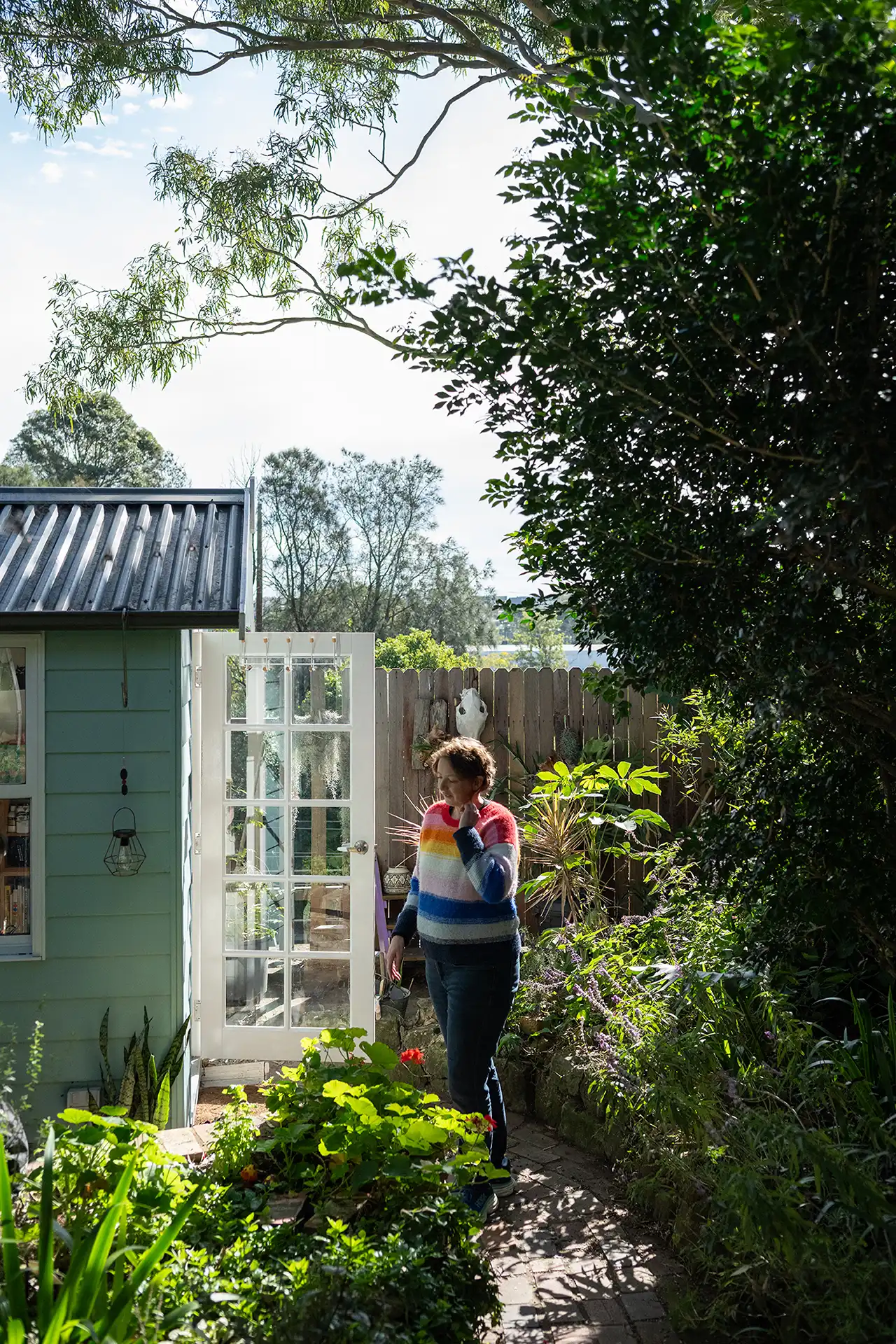
Bettina had been forced out of commercial studio space twice – once by developers, once by rising rents. Rather than repeat the cycle, she turned to her inner west Sydney backyard. Her Melwood Workshed gave her a permanent, purpose-built studio that no landlord can take away – divided into two zones, one for canvas work and one for design and book projects. Fitted out with sustainably sourced materials, bamboo flooring and paint from a local not-for-profit that rescues surplus trade paint. “I am very proud we continued the sustainable, local aspect of Greenspan,” Bettina tells us.

A writer’s retreat under the Robinia
Angela is a writer, not a painter – a reminder that a backyard studio isn’t just for visual artists. Her Melwood Mod 21 sits beneath a mature Golden Robinia tree in coastal New South Wales, the deck built around a junior tree to connect the building to the garden around it. Inside and out painted “Whisper White,” a chaise at one end, a writing desk at the other. Afternoon light and dappled shadows. Designed, as Angela describes it, for “writing and hanging out in the afternoon light.” Because a Melwood is the perfect creative retreat – for words as much as art.
The space your art deserves
A backyard art studio is one of the most personal spaces you’ll ever create. You make the rules about how it should look and be laid out, based on how it works for you.
What the tips in this guide have in common is this: the decisions that make a studio genuinely work should be decided before a single panel is made. Think carefully about light, about services, about how your practice might grow…
That’s why it’s important to work with a team that will help you design your art studio from the ground up – not pick a generic one from a catalogue.
Because get those foundations right, and what you’ll have is a space that’s always there, always ready, and always yours.
Ready to start designing your own backyard art studio?
Download our Design Price Guide for designs, sizes and pricing across the full Melwood range.
Already downloaded and ready to take the next step?
Let’s meet. Book a callback from one of our friendly team.
FAQs
It depends on what you make and how much space your practice requires. A solo practice with minimal equipment can work comfortably in 10–15m². For larger works, messier mediums, or a studio that might one day double as a gallery, display, or teaching space, a larger footprint gives you more flexibility. Leanne’s perfectly petite pottery studio measures just 2.6m x 3.6m – compact but entirely functional. Kathrin Longhurst’s professional artist studio is a Mod 21 at 3.7m x 5.4m. But you can go as large as 54m2 in size or as small as 8m2. Your Design Solutioneer can help you work out the right size and configuration for your needs and site.
Greenspan buildings are expertly PreCrafted – manufactured off-site as genuinely modular, ready-to-install components–including cladding, sarking and windows pre-fitted to wall panels, and roof frames fitted with Anticon blanket insulation and Colorbond steel roof sheets. These are then delivered to your property and installed on site. Most installations are completed to lock-up stage within a day. From there, the fit-out is yours to complete at your own pace. It’s a significantly faster and less disruptive process than a traditional build – and because manufacturing happens in a controlled factory environment, quality and accuracy are consistent every time.
The Mod is a very popular choice amongst artists of all kinds – its signature highlight windows flood the interior with indirect natural light without sacrificing wall space below, making it particularly well suited to detailed creative work. The Porch design is a close second, popular with ceramicists and potters who appreciate the covered outdoor space for drying work or storing materials. Equally, we have had many creatives opt for the Verandah or Workshed designs for their seamless indoor outdoor connection and internal height. Ultimately, it comes down to personal preference. The right design depends on how you work, what you make, and how the building will sit in your garden and with your home – your Design Solutioneer can help you find the right fit.